Wednesday, 19 November 2014

BFI trip

On the 12th November, me and my media class attended a study day which was held at the British Film Institute based at South Bank in London. This day was based on our AS Media Studies coursework of making an Opening sequence and give us techniques on how our work can be improved or set it to high standards.
Throughout the day, we had a speaker called Pete Fraser (Pete's Media Blog) who lead a talk about our coursework and the 5 key features that our title sequences should have. These 5 key features were: Genre, Narrative (enigma), Character, Atmosphere and Setting.

From this day, I learnt that when creating a opening title sequence that the title of the film should always appear near the beginning and never at the end of the sequence. If I did, then this would look more like a trailer rather than an opening title sequence.
I had also learnt that visual isn't only important and that sound is just as important. It is important that the sequence doesn't have any background noise such as cars and wind. When having this irritating noise in the background, most editors would use Foley so that the sound should sync in within the action.  
We had two visitors, Hannah Rothman and Derek Fletcher,  on the day to give us a talk about their success and their job roll in the media industry. Hannah Rothman is an editor for trailers and an associate director for Create Advertising London. She has edited and made a lot of successful trailers. Dexter Fletcher is an actor and also an director. He told us all about his career in acting and how he found it then he told us about his directing and the movies he has directed. 

Friday, 5 September 2014

Audience and Institutions

Powered by emaze

Film Marketing and Distribution.

Do your own research. Who are the key companies that market films? Which company would relate to your product the most and why?Consider this post alongside the following post before you write anything.

Film marketing is very expensive, as this is where the film goes into the market to be sold to an audience. Prices can increase if the product has a limited shelf life. Its more likely that the movie has to be a big hit when first brought out or at least a big hit on a weekend, otherwise it's unsuccessful for the company as they have a loss on their investment. 

Most block buster movies already have an audience. The studio has a greenlit a huge budget for the movie coming out because they already know people who will go and see it. This often happens because it is based on a media text that already has a wide audience.

Studios have a huge operating overhead, and put out a lot of flops that make no money at all, so they need a guarantee that a blockbuster movie is going to be make not just a small profit, but a comfortable one. After spending $100 million dollars on a movie they can spend 50% as much again (or more) on marketing.


Distribution is the process of launching a movie to the public or into the public place and then sustaining the publics views and opinions. For a movie to be financially successful, the film will need to be marketed, positioned and publicised.

Convergence

Convergence:
Technological convergence refers to the process where new technology is moving towards single platforms delivering multiple media outputs that can be used to reach audiences, for example, a PS3′s primary function is video gaming but you can download and watch movies from Lovefilm.com on it and also watch catch up TV and music videos.

Convergent technology is technology that allows an audience to consume more than one type of media from a single platform.
Lots of aspects of the internet e.g. social networking, YouTube, online editions of newspapers and magazines are convergent but candidates cannot quote the internet as the sole aspect of their answer. Their answer needs to be linked into the media area they are talking about (Film, Music, Magazines, Newspapers, Radio, Video Games). E.g if they were talking about newspapers you could link in to their online editions and talk about how this differs from the traditional paper version and the opportunities it presents or if talking about film, candidates could, for example, point to facebook campaigns advertising a film or viral marketing spread via the internet.
Digital projection is convergent technology because films that are produced digitally have moved away from the physical film medium and can be supplied to theatres in digital format (lower costs for distribution versus higher start up costs for theatres switching to digital technology). As the film is in digital format there are also cost savings as potentially less work needs to be done on the film to get it onto Blu-Ray, DVD, internet trailers etc as no physical conversion needs to take place because the film is already in digital format.
Cross Media Convergence is really a Business Studies term and refers to companies coming together vertically or horizontally (or both). The example often cited in exams is of Working Title making use of its parent company(s) to gain access to bigger stars and a better distribution network for their films.

Synergy

Note created by CaseyAmber with ExamTime


Film institutions

Powered by emaze


Media Ownership- When an organization owns more than one type of media company, for example a newspaper and a television station.

Media Conglomerate- A media conglomerate, media group or media institution is a company that owns large numbers of companies in various mass media such as television, radio, publishing, movies, and the Internet.

Media convergence - Two or more types of media coming together.
Synergy - Different elements of a company working together to promote related products.
Concentration of Media Ownership - the process by which an increasingly smaller number of companies own most media outlets.
Subsidiary - Smaller companies owned by a parent company.
Oligopoly - When the market is dominated by a smaller number of companies.

My Prod Co Ident

Pre-Prod Story Board.


Story board -


Explanation of Pre-production Work

Textual Analysis of OTS

What is a Log Line?

Log Lines.


A logline is a one (or occasionally two) sentence description that boils the script down to its essential dramatic narrative in as succinct a manner as possible.

Crucially, a logline contains all the elements necessary for the telling of a good story. It is written for industry professionals to show them that you can create a viable story for the script – a marketing hook alone won’t cut it.
One further note that you won’t like: A logline is the DNA of your script. If you can’t make the logline work, it’s probably because the story in your script doesn’t work. This is why some people suggest writing a logline for your idea before embarking on the script.


Flash Card Deck created by CaseyAmber with ExamTime


My Log line.
A young man suffering from short term memory loss caused by injuries in the army, uses photos and letters to track down his loved one who's kept in hostage. However the journey doesn't go to plan.

The Silence of the Lambs.
A young F.B.I. cadet must confide in an incarcerated and manipulative killer to receive his help on catching another serial killer who skins his victims.
Rated 18         118 min  -  Crime | Dram| Thriller31 May 1991 (UK)
Director - Jonathan Deme

The Silence of the Lambs (1991) Poster

Psycho.A Phoenix secretary steals $40,000 from her employer's client, goes on the run and checks into a remote motel run by a young man under the domination of his mother.
                109 min  -  Horror | Mystery | Thriller  -  8 September 1960 (USA)
Director - Alfred Hitchcock

Psycho (1960) Poster

The Imitation GameEnglish mathematician and logician, Alan Turing, helps crack the Enigma code during World War II.
       -  Biograph| Drama | Thriller  -  14 November 2014 (UK)
Director - Morten Tyldum.

The Imitation Game (2014) Poster

Analysing Previous AS students OTS.


This title sequence called 'Torn' is very well done. Immediately they have a wide ranges of camera shots and has used a great amount of edits for example the fuzzy image of the doll when he walks into his shed. They have used soundtrack which fits perfectly to the video as it creates a tense and freaky vibe. However they have placed their title at the end of the clip which makes it out to be like a trailer rather than opening title sequence. On the good side, they have used the right amount of credits. I would rate this as a level 3 because though it has followed the right rules, I would say its not intense enough and doesn't give us a clue of what kind of story we're about to watch.


The Vengenace opening sequence is good but I would rate it around a level 1/2 as i think it hasn't got the best quality in filming or editing. They have also left the title to the end of the opening sequence, which come across as a trailer. However there is some good points to this opening sequence, they have used a good amount of camera work and sound track plus the idea of someone creeping across though it does reveal a bit too much before the film would actually start.


This video hasn't got a title to it however a title 'Bloody Tears' stood out in capitals letter coloured red so I'm only thinking that was the title of this opening sequence. Unlike the other videos, they have actually placed the title near to the beginning, this is a advantage as it doesn't look like a trailer. This OTS also has the right amount of credits too. They have used a good range of camera movement and shots however they aren't the best quality. This feels as if it will be hard to carry out a movie after this opening sequence as we wouldn't really know where to begin, it gives away too much. At the end they have done really well with the overlapped speaking which comes across more tense and emotional.


I would rate this title sequence a level 2 because I think it needs better and higher quality. They have used a good range of shot sizes and only some good edits however they haven't experimented enough with different edits. This doesn't seem like an opening sequence as its given away too much already, normally it wouldn't reveal so much however this has already introduced the two main characters after one another. They have also placed the title at the end of the title sequence, giving the effect of an trailer.

Continuity Editing


Recreation of OTS.


The Dark Knight.

Sound in OTS

Note created by CaseyAmber with ExamTime

Credits – Length of / Number of / Placement of and Top Billing and Single Cards for Main Actors and timelines

It is common that an Opening Title Sequence will at least contain 24 titles within the credits. With no doubt the main characters would generally come first and the director last. With in credits, it is important that all the titles are the same length of time, same font and usually same font size unless it is a heading. 

When having popular actors in a film, it is more likely they will be introduced on their own single card. So for example if Julia Roberts was starring in a romance, her name would be introduce on screen on its own, without any other titles on the screen. For example; Jennifer Aniston has a contract for her name to be on her own card, to show the significance of their roles.


Credits can be shown on any background. There are some opening titles that have just a blank board behind it, or just a static image from the movie or it could even be a scene of action. When having static images and blank boards it comes across like a slide show and it works quite similar. 

For my opening sequence I will use this rule of having 24 titles, doesn't matter whether I have 24 people to include. Using 24 titles will make it look more professional and well presented. I would like my background to be pain backgrounds but also action involved in the background as I think it makes it more interesting and viewers get attracted easily. 


Analysis of TypeFaces/Positioning and Movement

If I define the word typography, Typography is the arrangement of words to create a sense of good design that will be appealing to the target audience. The arrangement of types involves selecting the point size, the style of type face, the line length, line spacing, letter spacing and adjustment of the spacing between lettering this is called kerning. Sans serif type faces have the connotation of being bold, balanced and traditional.

A Sans Serif is a category of typefaces which don't use serifs. Serifs is small lines at the end of each letter character. There are popular sans serif fonts which include Helvetica, Avant Garde, Ariel and Geneva. Serif fonts include Time Roman, Courier, Palatino and New Century Schoolbook.

Serif is the opposite to Sans Serif. The typeface has a decorative line added as embellishment to the basic font. The most common serif typeface is Times Roman. Here is an example of Serif font and Sans Serif.


Conventions of OTS

A opening title sequence is the method which film programs present their key title and credit productions. They would also show the cast members with in the title sequence. Opening credits of motion are mostly shown at the beginning and list the most important characters with in the film or program. These are either shown on a blank canvas or placed over a static image, sometimes they are also shown over the action which is sometimes accompanied by music.

Credits - last around 2 minutes. 
Theme tune
Title
Sense of film
Enigma 

History of Opening Sequences.


A History Of The Title Sequence from From Form on Vimeo.


This was designed as a possible title sequence which was for fictitious documentary. In this film it shows a history of the title sequence which includes all the names of famous title designers who had a revolutionary impact on the history and evolution of the title sequence. These names refer to specific characteristics of the revolutionary titles that they had designed. 

http://www.smashingmagazine.com/2010/10/04/the-art-of-the-film-title-throughout-cinema-history/ 

What are OTS?

A title sequence is the method by which films or television programs present their title, key production and cast members, or both, utilizing conceptual visuals and sound.

http://www.smashingmagazine.com/2008/12/19/30-unforgettable-movie-title-sequences/

A job of a opening sequence is to represent the film, trying to make a good first impression on the audience watching. A title sequence which has been well-crafted introduces the audience to the tone and theme of the film, not only crew and the cast.
However some film sequences aren't well made up, some have budgetary constraints which limits them to a simple, white text on black background however make it as good as possible. Some people prefer to take the minimalist road and omit the titles together which takes us straight to the action/story.

Explanation of Pre-Production / Production / Post-Production

 In media, Pre-production refers to the tasks which needs to be completed or executed before filming. These tasks include a many things  such as hiring actors or models, building sets, budgeting, planning, scheduling, renting for equipment and tests.

Production refers to the tasks that must be completed or executed during the filming. Production includes the tasks of setting up scenes, the capture of raw footage and the usage of set designs so that a few of the many pre-production tasks can be named. In film creation, production is the second step as it follows the pre-production phase and then evolves into the next which is post production stage.


Post-production refers to the tasks that must be completed or executed after the filming ends. Post production includes editing the raw footage to cut scenes, inserting effects of transitions and sounds, working with voice actors and dubbing. This is the third and final step in film creation as it follows after pre-production and production stage.


Pre-Production

Our Story.
Our opening title sequence will be about a Soldier with amnesia who has lost his loved ones and is determined to track them down. He receives a box of photos and love letters which will give him a clue to where they could be and who might have taken them.

 Log Line.
When a soldier discovers a box filled with photos and love letters, a former Soldier with amnesia vows to track down those he loves, only to discover someone has kidnapped each and every one.


Equipment List.
·        Camera
·        Tripod
·        Lights 
·        Back drop
·        Computer
·        Capable leads
·        Extension leads
·        Batteries and memory card for camera
·        Actors


Prop List.

·        Wooden Box
·        Photo’s
·        Love letters
·        Army Cadet outfit
·        Candles – lighter
·        Drama students/students  
·        Table
·        Table cover
·        Cupboard

Encoding and Decoding

The first Encoding and Decoding model of communication was developed by cultural studies scholar Stuart Hall. Stuart Hall is a cultural professor and theorist of Sociology who studied at the Open university. Hall has had a major influence on media studies. He claims that television and other audiences in media are presented with decoded messages, or either interpreted in different ways depending on the individuals cultural background, economic standing and personal experiences.

Stuart Hall looked at the role of audience positioning. Which was interpreted of mass media texts by different social groups. From this Hall came up with a model and suggested three ways that we may read media texts. These are the suggested three - 
  1. Dominant reading - this is where the reader fully accepts the preferred reading. Meaning audiences will read the text the way the author wanted them to. This would make the code seem natural and transparent.
  2. The negotiated reading - This is when the reader believes the code and accepts the preferred reading, however it sometime modifies it so that it reflects their own position, experiences and also interests.
  3. The oppositional reading - Readers which reject the reading. This is their social position which places them in an oppositional relation to the dominant code.

Audience Research Methods


How do we measure media audiences?

We measure media audiences in various ways, some methods can be to analyse sales, subscriptions, rating and figures.

Who measures audiences?

National Readership Study: The National Readership Study (NRS) was established in 1956 and today provides the most authoritative and valued audience research in use for print advertising in the UK. The survey itself covers 250 of Britain's major newspapers and magazines, showing the size and nature of the audiences they achieve. 


Broadcasters' Audience Research Board: The Broadcasters' Audience Research Board (BARB) is the organisation responsible for providing the official measurement of UK television audiences. BARB is responsible for providing estimates of the number of people watching television. This includes which channels and programmes are being watched, when they are watched and the type of people who are watching at any one times.


http://www.nrs.co.uk/
http://abc.go.com/
http://www.barb.co.uk/

Film Rating

The categories of film rating
U: Suitable for all
PG: Parental guidance
12: Video release suitable for 12 years and over
12A: Cinema release suitable for 12 years and over
15: Suitable for only 15 years and over
18: Suitable for only adults
R18: Adult works for licensed premises only.


Comprehending Time

When you watch a movie, the timing is always faster than actual time. Well screening isn't actually taken in real time. Films usually present whole lives presented in a short period of time and this is usually 90 minutes long however if it is a 60 minute long TV series or documentary it would normally take around 8 months. In some cases there are conventions which denote time passing, from the time/date information.

There are other devices which manipulates time such as;
  • Flashbacks. - Flashbacks are when a person thinks back to an event which may hold a memory or could solve into it.
  • Dream sequences - Dream sequences is a technique used in storytelling. It is mainly used to set a brief interlude from the main story.
  • Flash forwards - A flash forward takes the narrative forward in time from the current point in time. Flash-forwards are often used to represent events expected, projected, or imagined to occur in the future

Other time manipulation in films include:


  • Repetition
  • Pre-figuring of events that have not yet taken place
  • Reverse motion
  • Freeze frame
  • Ambiguous time


    Flashback.


Flash forward.


My Audience


Audience Positioning

New Media Terminology to Use in Blog and Essays:

Audience Engagement 
This describes how an audience interacts with a media text. Different people react in different ways to the same text.

Audience Expectations 

These are the ideas the audience have in advance of seeing a media text. This particularly applies to genre pieces. Don't forget producers continually play with or shatter audiences expectations.
Point of View.


A point of view shot is a short film scene where it shows what a character or subject is looking at or what is represented through the camera. It is usually established by being positioned between a shot of a character looking at another object and also showing the characters reaction (here they would use a shot reverse shot). The technique of point of view is of the foundations of film editing.
The point of view shot doesn’t need to be strict straight front on a single character in film but can also be taken over the shoulder of the character, who remains visible on the screen. Sometimes the point of view shot is shared with other characters and represents the joint view of how many characters.
Bird's eye.

Bird eyes view is a view which is directly overhead or could say over the top of the subject which is unusual angle. Objects from this angle is more likely not to be recognised for example umbrellas in a crowd. However this shot puts the audience in a god-like positioned and looking down onto the action. Through this shot people can be made to look insignificant, ant-like, part of a wider scheme of things.

Shot reverse shot.

Shot reverse shot is a editing of dialogue sequences. It relates with 180 degree rule and the eye line match. Shot reverse shot is a film technique where the 1st character is shown looking at another character (2nd) and then the 2nd character is then shown to be looking back at the 1st character. Once this is repeated viewed a few times, the viewer’s unconsciously assumes that they are looking at each other.  

Audience Classification


Audience and groups:
Group A:

  • Doctors
  • Scientists
  • Lawyers
  • Well paid professionals

Group B:

  • Teachers
  • Middle management
  • Fairly well paid professionals
Group C1:
  • Junior management
  • Bank clerks
  • Nurses
  • 'White collar' professions
Group C2:
  • Electricians
  • Plumbers
  • Carpenters
  • 'Blue collar' professionals
Group D:
  • Manual workers such as;
  • Drivers
  • Post sorters
Group E:
  • Students
  • Unemployed
  • Pensioners  
Qualitative research is primarily exploratory research. This is used to gain an understanding of underlying reasons, opinions and motivations. It provides a lot of depth of information into the problem or could help develop ideas for potential quantitative research. This is also used to uncover trends in thoughts and opinions, and then goes into further depth into the problem. The data collection methods vary using unstructured or semi-structured techniques.

Quantitative Research is used to quantify the problem by generating numerical data or either the data can be transformed into useable statistics. This is used to quantify attitudes, opinions, behaviours, and other defined variable. This will also generalize results from a larger sample population. This method uses measurable resources and data to formulate facts and uncover patterns in research. These methods are a much stronger and better method than Qualitative method.
 This is evident where as quantitative data collection methods include various forms of surveys – online surveys, paper surveys, mobile surveys and kiosk surveys, face-to-face interviews, telephone interviews, longitudinal studies, website interceptors, online polls, and systematic observations.


Impact of Technology on Audiences.

This post is on a computer which is in the editing suite.


Impact on audiences

How do we measure media audiences?
We measure media audiences in various ways, some methods can be to analyse sales, subscriptions, rating and figures.

Who measures audiences?

National Readership Study: The National Readership Study (NRS) was established in 1956 and today provides the most authoritative and valued audience research in use for print advertising in the UK. The survey itself covers 250 of Britain's major newspapers and magazines, showing the size and nature of the audiences they achieve.

 
Broadcasters' Audience Research Board: The Broadcasters' Audience Research Board (BARB) is the organisation responsible for providing the official measurement of UK television audiences. BARB is responsible for providing estimates of the number of people watching television. This includes which channels and programmes are being watched, when they are watched and the type of people who are watching at any one times.

Audiences - Mass and Niche

Note created by CaseyAmber with ExamTime

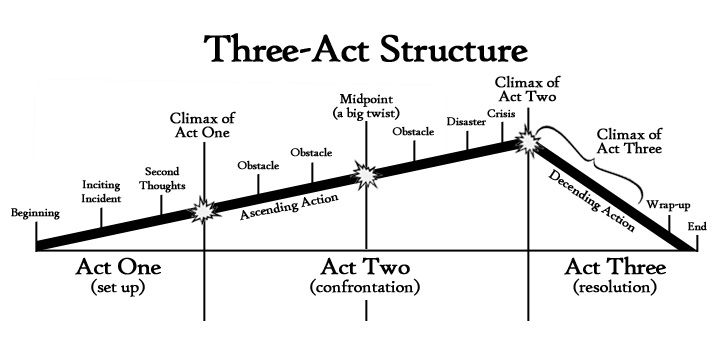
Narrative - Three act structure.


Act I - The first act (Act I), compromises the first quarter of the screenplay. (For a two hour movie, Act  I would be approximately 30 minutes)

What happens in Act I? (Setup)

Exposition: The part of the story that gives the characters an introduction, this basically gives the audience an insight of the characters and what type of characters they are; it shows some of their interrelationships and place them within a time and place.

This part of the story introduces three separate aspects; the main character, the dramatic premise and the dramatic situation.

Main Character:  The person in the story who has a need/object to achieve and whose actions determine the drive of the story.

Dramatic Premise: What the story itself is about

Dramatic Situation: The circumstances which is surrounding the action.

Inciting Incident - An event that sets the plot of the film in motion. It occurs about halfway through Act I.

The ''Plot Point'' - According to field, the three acts are separated by two plot points. A plot point (which is sometimes referred to a reversal) is an event that thrusts the plot in a new direction, leading into a new act of the screenplay. Later screenplay gurus have built on Field's theory by stating that plot point #1, which leads into Act II, is the moment when the hero takes on the problem.Act Two

Act II - The second act (Act II), compromises the next two quarters of the film. (For a two hour movie, Act II would approximately be 60 minutes)

What happens in Act II? (Confrontation)

Obstacles - In the second act, the main character encounters obstacle after obstacle that prevent him from achieving his dramatic need.

First Culmination - This is the point just before the hallway mark of the film where the main character seems close to achieving his or her main goal/objective. Shortly afterwards, everything falls apart which then leads to the midpoint.

Midpoint - This is the point approximately halfway through the film where the main character reaches his/her lowest point (weakness) and seems very far away from fulfilling the dramatic need/objective.
Act Three

Act III - The third and final act (Act III) comprises the final quarter of the film. (For a two hour movie, Act III would approximately be the final 30 minutes)

What happens in Act III? (Resolution)

Climax (Second Culmination) - This is the point at which the plot reaches its maximum tension and the forces in the opposition confront each other at a peak (highest/tension point) of emotional or physical action.

Denouement - The brief period of calm at the end of the film where a state of equilibrium (which was seen at the start of the film) returns.


Three Act Structure on The Dark Knight.


Narrative and Its 6 Codes.

Narratives 6 codes.
  • Technical Code - anything 'technical' that goes into a narrative, e.g. camera, sound, design and editing. 
  • Verbal Code - how language is used, written and spoken.
  • Symbolic Code - clues within the narrative
  • Structure - Todrov's theory. Equilibrium
  • Character - protagonist, antagonist, side helper, donor, mentor and father.
  • Narrative conflict - Levi-Strauss' theory that all narratives are moved forward by a conflict caused by opposing forces


The story of this film is Clarice is put in charge of finding a woman who has gone missing, from a serial killer. This is represented in the opening title sequence as it starts off with an establishing shot of a dark, misty forest which suggests an mysterious but gloomy effect and this may put the audience into a uncomfortable but wondering mood. The camera tilts down towards the woman and turns into a extreme long shot of the woman (Clarice). She is running through a forest and has an overall messy appearance and when running she is running through an obstacle course which looks pretty intense and hard to do, this shows her hard working and determination. This determination then relates back to the story as she is the finding the killer, she is determined to find them and get revenge.  The protagonist of this film is an FBI Agent, Clarice Starling. The antagonist of this film is a psychopath Hannibal Lecter. 


Narrative - Enigma, Story and Plot

Narrative - Narrative is the order in which film is told. In terms of Media, narrative is the organisation of media texts which means story. A human uses narrative in its head to make sense of thing. Therefore we all connect events and make interpretations based on those connections. Narrative is correlated with genre as same genres have typically known story line.

Narrative Enigma - the purpose of narrative enigma is that it engages audiences attention, which keeps them curious and interested with the narrative. This is essential to when a programme creates their own title sequence.

Difference between narrative story and plot.
A narrative story is what happens in the film which includes a backstory however a narrative plot is the order in which the story is told throughout the film.
If I was to put the series of crime events from a narrative story, it would more than likely go like this:
  • Crime conceive > Crime planned > Crime committed > Crime discovered > Detective investigates > Identifies criminal.
However if I was to make it more interesting and re-arrange into a different sequence, the plot would be:
  • Crime discovered > Detective investigates > Identifies crime > Crime conceived > Planned crime > Committed crime.  

Hybrid Genres and Sub Genres.

Film genres are identifiable types, categories, classifications or groups of films that have similar techniques or conventions such as:
  • Content
  • Subject matter
  • Themes
  • Mood
  • Period
  • Plot
  • Settings
  • Recurring icons
  • Narrative events
  • Motifs
  • Styles
  • Stars
  • Props
  • Stock characters

I didn't produce this slide share, I found it. I chose this to go on my blog because I think this is helpful to me as it gives me facts and information about genres.

Neale (2003) points out that generic norms and conventions may be recognized and understood by audiences, readers and viewers. Genre frames audience expectations, whereby viewers bring a set of assumptions with them and anticipate that these will somehow be met in the viewing experience. This brings audience pleasure. The demands of commercial practices necessitate that generic forms must somehow ‘guarantee meaning and pleasure’ in order to locate and retain a sizeable audience to justify a return on substantial investment. 

Hybrid Genres.

A cross-genre (or hybrid genre) is a genre in fiction that blends themes and elements from two or more different genres. As opposed to the (literary and political) conservatism of most genre fiction, cross-genre writing offers opportunities for opening up debates and stimulating discussion.


Subgenre.

Subgenres are identifiable subclasses almost like a sub-heading however within a larger genre. They have their own subject matter, style, formulas and iconography.


What is a Thriller? Thriller Genre

A Thriller is a genre of films or television, which creates suspense, tension and excitement as their main elements. Thrillers stimulate the viewer's mood also giving them a high anticipation and maybe uncertainty, anxiety and terror. These types of films normally tend to be adrenaline-rushing and fast pace to create the tension and suspense. Its more than likely a Thriller will provide the viewer a rush of emotions and excitement which brings them to the edge of their seats. Thrillers tend to be psychological, threatening, mysterious. Cliff hangers, plot twist and red herrings are used quite a lot in Thrillers to keep the viewers intrigued and kept wondering.  Most Thrillers will include protagonists and antagonists to create the excitement story of battling against one another.

Here is a link of Old fashioned Thriller films; http://www.screenonline.org.uk/film/id/444810/index.html

List of recent Thrillers;
  • Left behind
  • A Walk Among the Tombstones
  • As Above, So Below
  • The Maze Runner
  • The Equalizer
  • The November Man
  • Divergent


I have chosen the trailer The Equalizer to present the genre of thriller. I have done this because I think it creates tension, suspicion with action beside it. This also uses a lot of excitement, cliff hangers and plot twists.

Defining Genre

Mind Map created by CaseyAmber with ExamTime

Representation Of Men and Women


This is a opening sequence of a thriller movie called Seven ( Se7en). Looking through this sequence it seems to only have one guy. This tells us that this man could be the dominant role, who is mostly important in this movie. As he is an important part, he could be the antagonist to the movie or either the protagonist. However from this sequence he has a lot of equipment and evidence of being the antagonist to the movie, we know this from the amount of information, photos and equipment he has used throughout this sequence.
We can vaguely guess who old this man is. I have a faint idea that the man is middle aged. As we don't actually see his face, we could get an idea from his hands, as they look worn out, old and wrinkly. By noticing this we can tell that he's been a long time, hardworking man and they don't exactly look fresh and young. If you notice all the equipment he has and what he has done, it comes across quite professional and smart therefore it shows his experience.
This mans ethnicity would be English/American as we know from the skin colour from his hands and knowing this an American movie, we'd be sure they were American. Their class and status seems to be quite upper class as we can see the equipment and technology they use. Plus seeing the plans and ideas through his book give us a hint of the man being intelligent and smart. We can't quite tell his ability but when looking at his intelligence we might have a clue that he is able however with his plans and intelligence some may say he has a mental ability, as the plans aren't natural to do.
Watching through this sequence there isn't a female role involved however if there was, she would of been the same ethnicity and ability However the class and age could be different as the man could be attracted to the younger generation and some which either have a high class or lower class than him depending on what his aim to do.

What is Representation?

Representation is how people, an idea or events are represented in a film or programme to set a character.

Representation includes these titles:
  • Gender
  • Age
  • Sexuality
  • Disability/ability
  • Regional
  • Stereotypes
  • Class and status


Evaluation of Preliminary Task

Evaluation-
My group were Jamie, Heather, Josh and Henry. I personally think my group worked well together as we had our own jobs to do and worked as a team. We had an extra person join throughout our filming therefore we had to redo our filming however it didn't slow us down and we done much better team work than previously. Three of us made the filming, I was one of them and two people were in our clip. I think the people who were in our clip worked well however there were times when they messed around but when it came to filming they would do really well and not be stupid. As they were messing around, it was hard for the film people to concentrate and get work done as quick as possible, plus the accurate position and shot size. However I think we worked really well together as we each had a turn on different angles and shots and as Jamie hasn't done media before he experienced new directions and shots with the camera. After filming we worked really well together as a group going through our film and editing each camera scene. Josh, Jamie and Heather hasn't experienced editing before there me and Henry would guide them through, helping them so that they will understand next time they use editing. However the boys would go a little over board and mess around with ideas that weren't even relevant to our topic.
If I were to do it again I  would rethink about the shots and camera position, as I look back through the videos and think they are slightly off target and positioning. I would also think about the story line of the task and think of something differently and more intense. The task was to use a different but certain angle shots and camera size shots in the scene of a boy walking into a room and basically sitting down with another person. I do believe the task we done met the brief and our task was done accurately and also sensibly.
This task was quite easy when I come to think of it, although it was hard with a few people in the group. The only time it was hard, is when we had to think about our positioning in the room and how we  can make the film flow nicely.
Throughout this task I have learnt different angles and filming shots that I haven't experienced or done before. I have enjoyed learning this as I can now learn and improve the opening sequence which I will be filming next.

Storyboard.

The Prelim Task

The Prelim Task.

In groups of no more than four this is a task involving filming and editing a ''Character opening a door, crossing a room and sitting down in a chair opposite another character with whom he or she exchanges a couple of lines of dialogue". This task must demonstrate match on action, shot reverse shot and the 180 degree rule.


Textual Analysis of the OTS....

Art of the Title


In this opening title sequence of James Bond Skyfall, they have used the song "Skyfall" by Adele which is played over the top of the cinematography. This song was specifically made for the movie as it connotes Bond's mission called Skyfall which is what the movie is about therefore this choice in soundtrack works perfectly against the scene.

Firstly, as we see James bond fall into the water the camera stays still however follows his body floating down into deep waters and this would be called a tilting shot. Few scenes after we have an angle which looks down towards his feet, which he is being sucked into a plug hole. This gives an effect to the audience as they may feel that they're James Bond floating down because it seems as if he is looking towards this feet.

When the gun drops to the bottom of the water, a cemetery has been built with gun headstones. They have used fast tracking edit to go through the scene, so as if the audience is walking through it and this carries on going through the woods until we end up at a crack with Bonds eye showing.
There is more tracking when we go through the building and bond shooting towards the screen.

This opening shows a lot about the one dominant person as it only involves him. It involves enemies however they are only showed as a shadow because if they were to show the faces they would ruin the movie so this holds suspicion for the audience to wonder until they get introduced to the enemy.

Mise-en-scene; Bond outfits and looks reveals that he is ready to do business, he's always smarted and tarted up showing he is high class and typically his job is very important. Bonds body language shows a lot about himself as its quite tense and alerted for when the enemies come therefore showing he is brave and ready for whatever comes at him.

Throughout the whole opening sequence they have used shapes of objects such as guns, knifes and objects. This effect connotes the theme of the movie and what the movie is about

Superman/Batman: Public Enemies (2009) — Art of the Title

Through Superman/Batman: Public Enemies we can immediately tell what ethnicity this comes from, which is America and we can tell as the second screen is an American flag. There is also the Statue of Liberty which also appears after the american flag.

Mad Men (2007) — Art of the Title